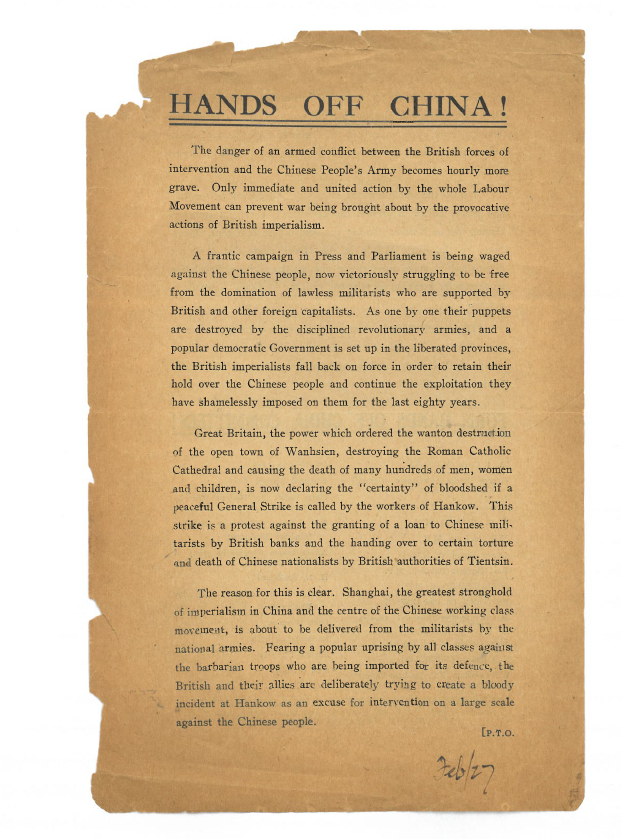
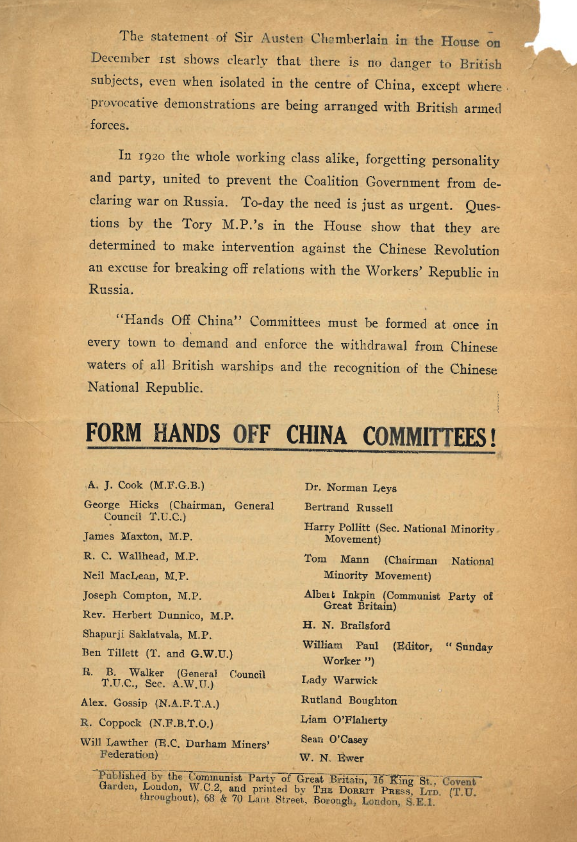
My thanks to the great collector of all things Chinese ephemera, Roy Delbyck in Hong Kong for this rare copy of a Communist Party of Great Britain leaflet on China from February 1927. .
General strike in Hankow, trouble in Shanghai and particularly The Wanhsien (Wanxian) Incident of 1926, a series of maritime conflicts on the Yangtze between British merchant shipping and regional Chinese military leaders, culminating in a battle with Royal Navy gunboats, which also fired cannons into the city of Wanxian. In 1926, while China was in the midst of the Warlord Era, Sichuan province, surrounded by mountains, was fighting its own civil war in which local militants were backed by various Chinese warlords. In May, Chinese Marshal Wu Peifu, facing an imminent threat from Chiang Kai-shek‘s Northern Expedition campaign, appointed General Yang Sen as the Governor of Sichuan. The latter had used British commercial shipping to transport troops along stretches of the river Yangtze.
All this, so the Communist Party of Great Britain (founded in 1920) believed made the possibility of war between Britain and China imminent. And so they issued the leaflet below – “Hands Off China!”
It’s interesting as well to see who was on the British Hands off China Committee. Many of the big names on the British revolutionary left at the time – Cook, Maxton, Tillett, Tom Mann as well as Harry Pollitt who be the long time leader of the CPGB. Also featured is the left intellectual Bertrand Russell (who wrote the 1922 book “The Problem of China”), as well as the Irish novelist Liam O’Flaherty and poet Sean O’Casey
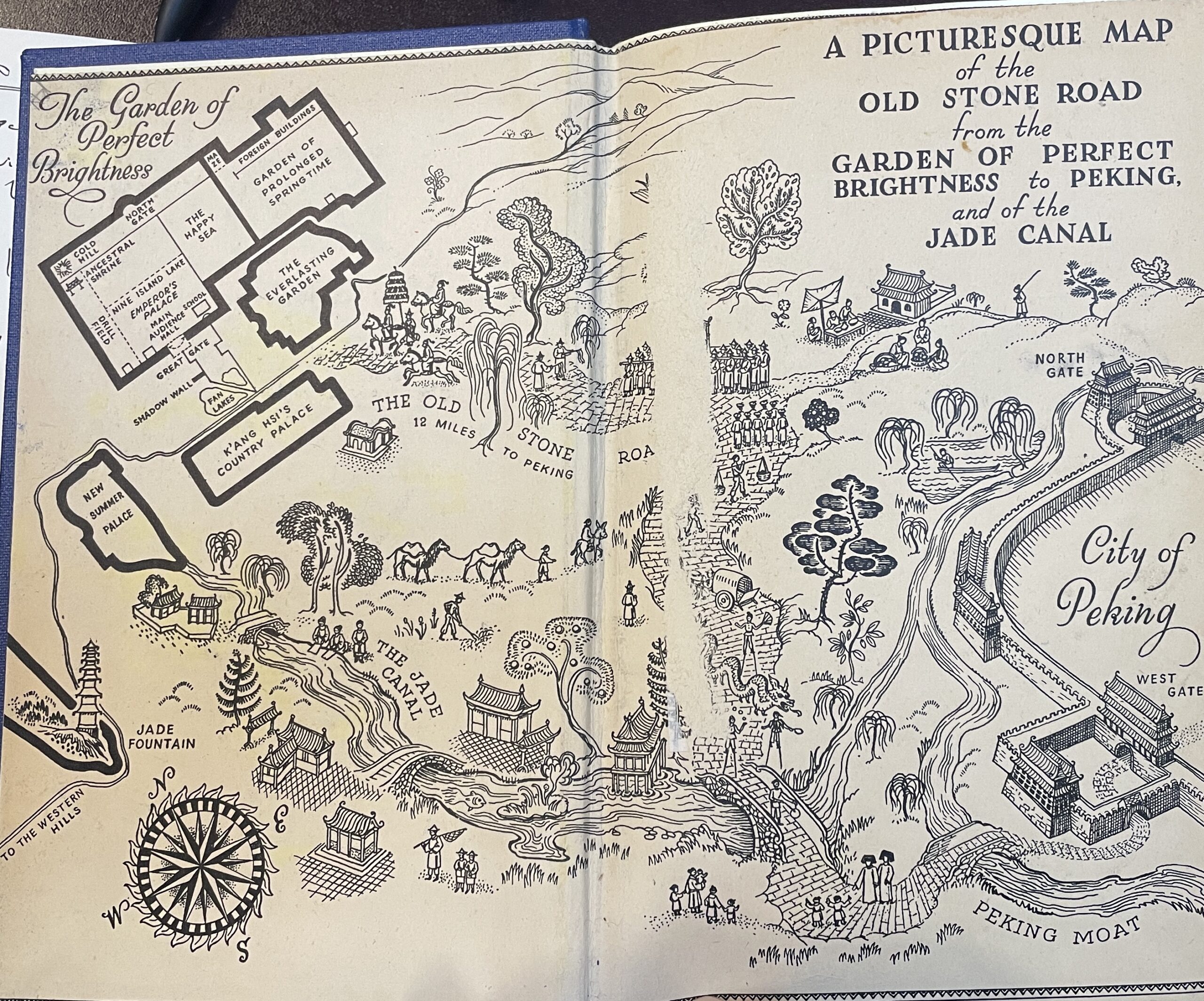
Summer Palace (Yuanmingyuan) map from Hope Daby’s The Garden of Perfect Brightness: The History of the Yüan Ming Yüan and of the Emperors Who Lived There (Williams & Norgate, London, 1950). Illustration designed by Scottish artist and illustrator William McLaren (1923-1987).
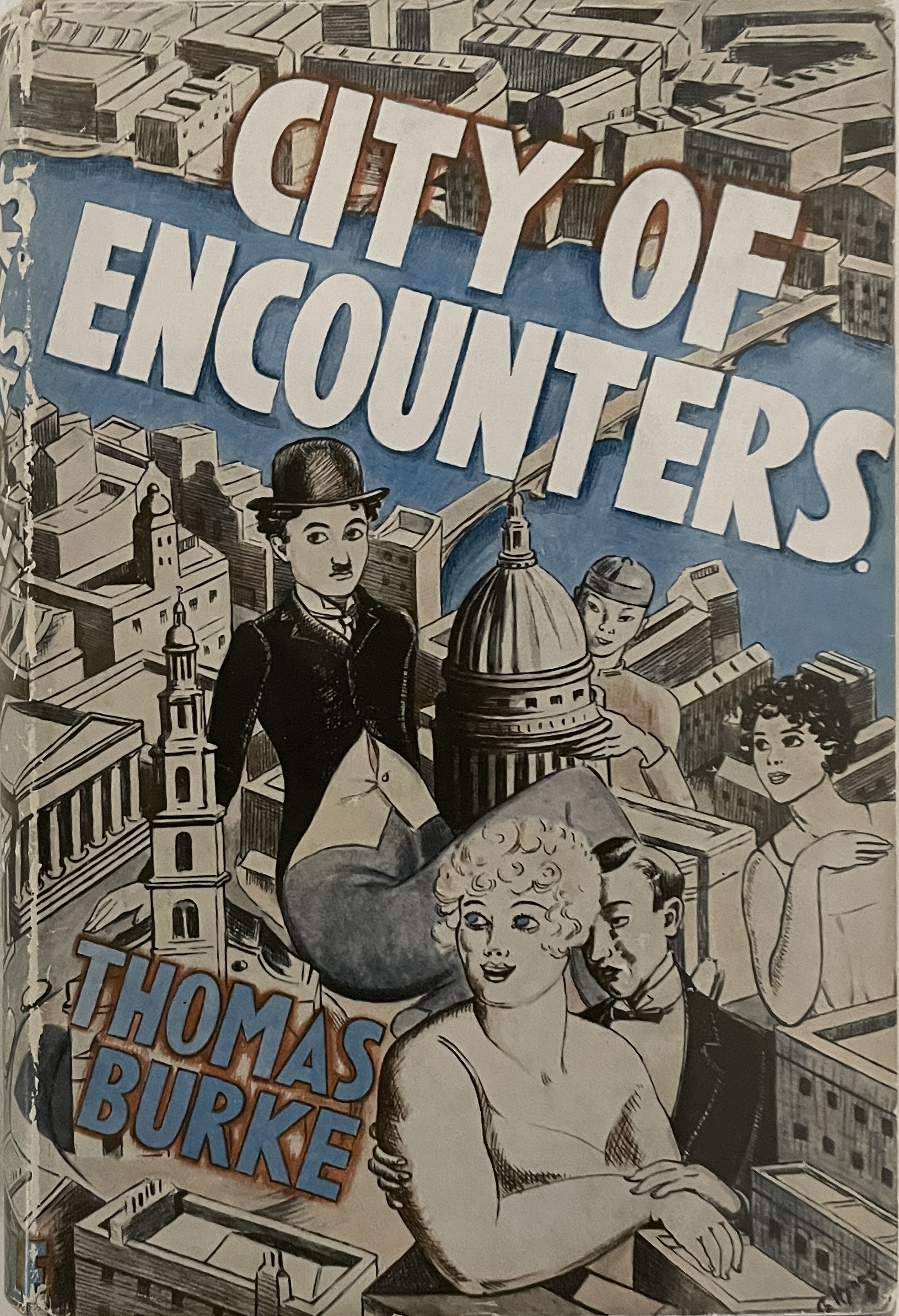
The front cover of the 1932 first edition book City of Encounters: A London Divertissement (Constable & Co.) by Thomas Burke, featuring a jacket design by the artist Gladys Hines.
From the New York Times review in 1932 – ‘a deeply atmospheric, episodic volume that blends personal memoir with sociological character sketches. Rather than serving as a standard layout of a city or a catalog of streets and historic landmarks, Thomas Burke treats London as a living, breathing landscape of distinct human personalities.’
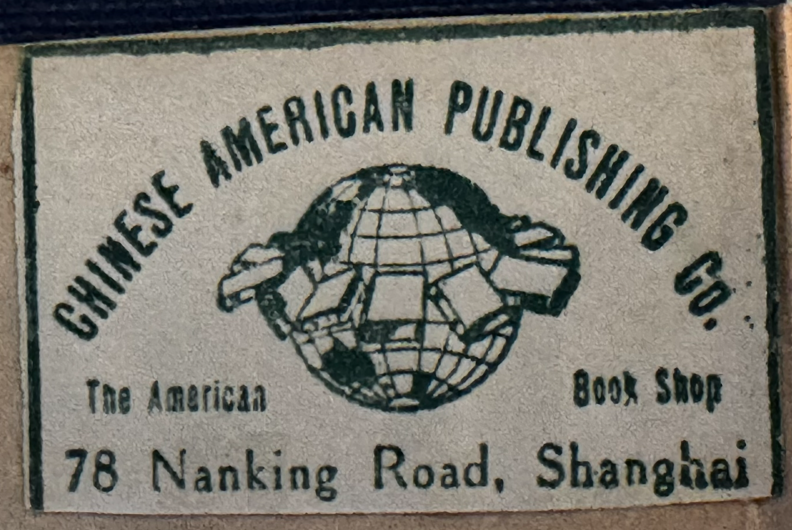
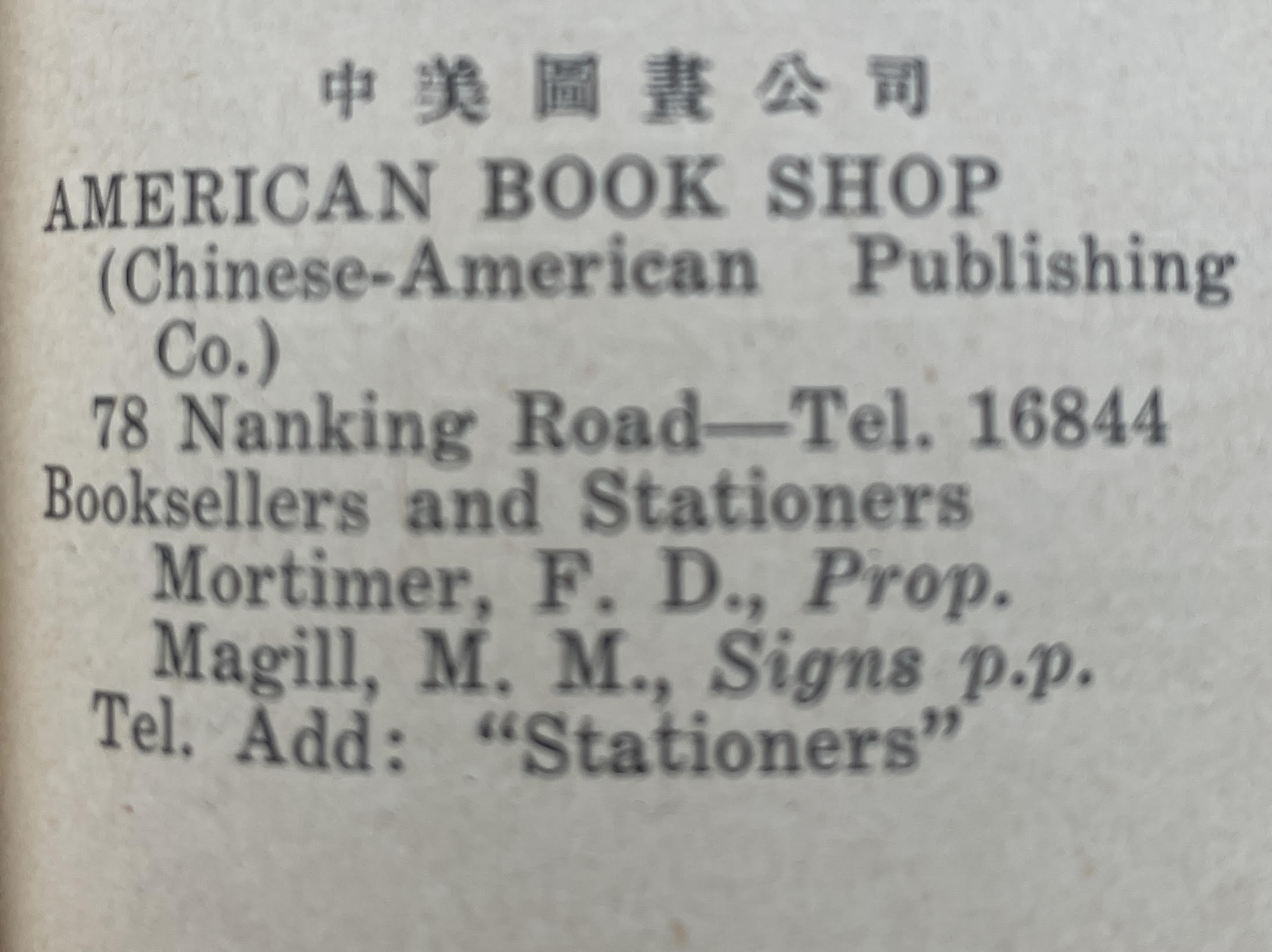
Another gift from the old China collector Ed Lanfranco, ex of Beijing and now of California. An ex-libris from the inside cover of a book showing it was purchased at the American Book Shop at #78 Nanking Road (Nanjing Dong Lu), Shanghai. The Book Shop was part of the Chinese American Publishing Company run by well known American Shanghailander and Great War veteran Frank “FD” Mortimer….
Anna May Wong shows the real woman behind the actress’s facade and will inspire a new generation of writers, image creators, fashionistas, and television and film enthusiasts in the 21st century.
Wong’s dazzling talent is not in question, yet what often goes unsaid was her feat of perseverance in the face of cinematic and theatrical rejection as well as daunting societal barriers such as the Chinese Exclusion Act and racialized housing segregation.
Her legacy spans through her 50-plus films, pathbreaking television series, sumptuous fashion looks, Broadway and vaudeville shows, iconic photographs, groundbreaking journalism, and global fame, making her one of the only Asian American actors to become a household name.
Wong’s lack of obedience to a heteronormative lifestyle in conjunction with her wild sexual encounters, debauched night life, and friendships with cultural figures such as Walter Benjamin, Marlene Dietrich, Ramón Novarro, Vincent Price, Rosa Rolanda Covarubbias, Philip Ahn, Hedda Hopper, Carl Van Vechten, Evelyn Waugh, Blanche Knopf, and Paul Robeson, shed light on what it meant to be a trailblazing actress almost a century ago.
Anna May Wong uses the actress’s own personal correspondences, never-before-seen archival photos, and creative endeavors such as her writings published in the New York Herald Tribune and her self-made film about China (broadcast on ABC) to tell the story of the “World’s Most Beautiful Chinese” American woman, who rose past the boundaries of the silent and studio eras of white Hollywood.
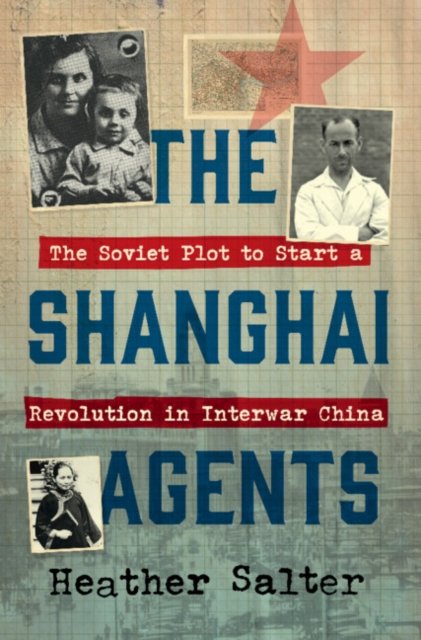
“Heather Salter uncovers a remarkable secret history of espionage and counterespionage, repression and resistance, corruption and courage, heartbreak and betrayal in Shanghai between the world wars.
At the heart of this story lies the fate of Tatyana Moiseenko and Yakob Rudnik – known then only as Paul and Gertrud Ruegg – a couple arrested, tried, and imprisoned for running a clandestine communist spy ring.
Against the backdrop of the battle between communism and anti-communism that would shape much of the twentieth century, this dramatic history provides a uniquely human perspective on the global volatility of the 1930s.
Through Tatyana and Yakobs’ eyes, Salter traces global police networks, MI6 in China, and the worldwide reach of the Comintern to shed light on the deep historical roots of antagonism between Russia, China, and the West.”
“that indefinable eccentric something…O.W. Philips describing Reginald Johnston: “Sinophile to a degree which tended to warp his judgment on any Anglo-Chinese issue, had that indefinable eccentric something that pervades all those westerners who have made a deep study of China and Chinese.”
The Last Emperor of China: Twilight of the Forbidden City (Elliot & Thompson) is out now in the UK; US in November.