Posted: March 1st, 2015 | No Comments »
The US First edition of Sax Rohmer’s The Mask of Fu Manchu, published in 1932 by The Crime Club. The Mask of Fu Manchu was originally published as a twelve part serial in Collier’s magazine from May 7, 1932 through July 23, 1932. The cover of the May 7 issue utilised artwork by W. T. Benda (on whom more here)….

Posted: March 1st, 2015 | No Comments »
Now in paperback and a great read….

n 1659, a vast and unusual map of China arrived in the Bodleian Library, Oxford. It was bequeathed by John Selden, a London business lawyer, political activist, former convict, MP and the city’s first Orientalist scholar. Largely ignored, it remained in the bowels of the library, until called up by an inquisitive reader. When Timothy Brook saw it in 2009, he realised that the Selden Map was ‘a puzzle that had to be solved’: an exceptional artefact, so unsettlingly modern-looking it could almost be a forgery.
But it was genuine, and what it has to tell us is astonishing. It shows China, not cut off from the world, but a participant in the embryonic networks of global trade that fuelled the rise of Europe – and which now power China’s ascent. And it raises as many question as it answers: how did John Selden acquire it? Where did it come from? Who re-imagined the world in this way? And most importantly – what can it tell us about the world at that time?
Brook, like a cartographic detective, has provided answers – including a surprising last-minute revelation of authorship. From the Gobi Desert to the Philippines, from Java to Tibet and into China itself, Brook uses the map (actually a schematic representation of China’s relation to astrological heaven) to tease out the varied elements that defined this crucial period in China’s history.
Posted: February 27th, 2015 | 4 Comments »
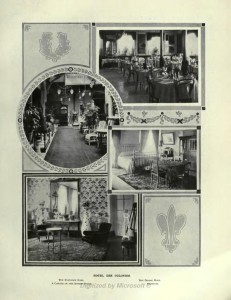
A nice advert for the old Hotel des Colonies on the Rue du Consulat (Jingling Road now though the hotel is long gone) in Frenchtown showing its rather sumptuous interior….
Posted: February 26th, 2015 | No Comments »
An impressive shot of Kiukiang Road (now Jiujiang Road) in the 1920s reflecting the whole “Wall Street of the East” image the city built up….

Posted: February 25th, 2015 | No Comments »

Understanding China, the Country and the Myth
Writer and broadcaster Isabel Hilton who has written extensively on China will be joined in conversation by Anne Witchard, whose research investigates changing conceptions of China in Britain. They will be joined by Jonathan Fenby, author of Will China Dominate the 21st Century?,  to discuss one of the most influential countries in the world today.
More details here

Posted: February 24th, 2015 | No Comments »
In 1930 or thereabouts a circus visited Shanghai and camped out on some waste land behind the Astor House Hotel in Hongkew. However, security was not all it might have been and a wild tiger, part of the show, escaped and sought freedom in the lanes and alleyways north of the Soochow Creek. It first came to the Shanghai Municipal Police’s attention when it scratched a rickshaw puller who was sleeping next to his vehicle down near the Bund. Not too badly as the puller made it the Central Station (which means he couldn’t have been that badly scratched or alarmed as the Central Station was across the Soochow Creek, over the Garden Bridge and up on Foochow Road – Fuzhou Road if you prefer).
A police officer (called Conning in some accounts – though no officer of that name was ever in the SMP to my knowledge) headed over the wasteland behind the Astor with a nice piece of bloody steak – tied it to a stake and sat back and waited to see if the tiger would appear. The European officer took along a Sikh constable with him. They eventually found the tiger in the Summer House at the Public Gardens on the Bund, what is ow Huangpu Park.
Approaching the Summer House the European officer lobbed in the bloody steak to entice the tiger out and grapsed the rope ready to haul in the beast. Rather than wait and see what the plan was once the copper had a live tiger, that had tasted blood, on the end of a short rope the Sikh officer rather wisely took out his .455 revolver and shot it.

The old Public Gardens on the Bund with the summer house where the tiger lurked to the left of the bandstand
Posted: February 23rd, 2015 | No Comments »
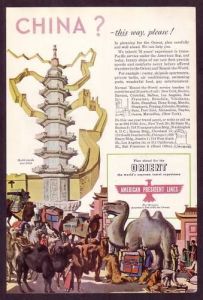
Get a last gasp of China before it goes Red and Commie in the late 1940s with American President Lines….tourism was about to be off the Maoist agenda!!
Posted: February 22nd, 2015 | No Comments »
Colin Watson’s eminently (still) readable 1971 history of crime writing, Snobbery With Violence, argues that (in England) just before and around the time of the First World War, ‘…drug taking, being expensive, was mainly the indulgence of wealthy and often well-connected people.’ True if you include the worlds of the underbelly and the theatrical. He goes on to note that therefore memoirs of drug taking are invariably few and far between and mostly by the wealthy and privileged. However, this got me thinking, this was not the case in the Far East where drugs were much more affordable closer to source and so pretty much anybody wishing to indulge could. This reminded me of James S. Lee’s druggie memoir Underworld of the East, first published in the 1930s but covering the period from the late 1890s to the early 1920s. Lee, a jobbing English engineer with a taste for narcotics and travel talks of his drug taking experiences in Africa, Brazil, Malaya, India, London and, of course, Shanghai. His Shanghai experiences involved opium, morphia, cocaine and other delights such as drink, prostitutes and pornography in the city in 1906-1907. It is, of course as with such a sensational memoir, long argued as to the complete truth of his memory, but is still interesting. I note that, while originals are hard to come by, it was republished some time back and so worthy of a mention here….


