Shanghai’s temperature hovers in the mid-30s (just shy of 90 degress in old money) with humidity around 63% – i.e. sweltering and sweaty. Fortunately in 2009 we stick the air-con on. In the 1930s the only way to get some relief might have been to call German refugee Ralf Harpuder and his block ice business based at 978 East Seward Road (now Changzi Road East). Seems it might have helped if you spoke German.
My great hero George Orwell wrote an essay in 1946 that all published, not yet quite published, wanna-be published and ever hopeful writers should read. It was simply called Why I Write. Owell outlined four reasons:
1. Sheer egoism– Orwell argued that many people write simply to feel clever, to “be talked about, to be remembered after death, to get your own back on grown-ups in childhood, etc.” He also says that it exists more in serious writers than journalists, though serious writers are “less interested in money”.
2. Aesthetic enthusiasm– Orwell explains that present in writing is the desire to make one’s writing look and sound good. He says that this motive is “very feeble in a lot of writers” but still present in all works of writing.
3. Historical impulse– He sums this up by simply stating this motive is the “desire to see things as they are, to find out true facts and store them up for the use of posterity.”
4. Political purpose – Orwell writes that “no book is genuinely free from political bias”, and further explains that this motive is used very commonly in all forms of writing in the broadest sense, citing a “desire to push the world in a certain direction” in every person. He concludes by saying that “the opinion that art should have nothing to do with politics is itself a political attitude.”
As ever of course Orwell (who never did a China book tour) is right but what do you actually get for free when you book tour China in these recessionary times? Having just completed a mini-book tour of China here’s a round up of the tangible stuff you can get while promoting a book in China place by place and in the order I did them:
M on the Bund Shanghai – a very good 3-course dinner and as much wine as you can drink
The Bookworm Suzhou – excellent pizzas and as much beer as you can drink
The Bookworm Beijing – plenty of beer, excellent toasties and a rather sweet Bookworm notebook
The Yin Yang Centre Beijing – wine and some homemade biscuits
The Beijing FCC – plenty of beer and a Beijing FCC T-shirt
The Hong Kong FCC – pre-speech G&Ts, a decent lunch with wine, a HK FCC reporters type notebook and a HK FCC polo shirt
The Hong Kong Royal Asiatic Society – a nice hardback copy of William Hunter’s An American in Canton (a great book) and drinks in the Captain’s Bar over at the Mandarin Oriental afterwards
The Shanghai FCC – beer, a complimentary nachos like thing and an Shanghai FCC T-shirt
It goes without saying that all the above venues and organizers also provide excellent audiences, conversation and, thankfully, wonderful people who buy books and I’m extremely grateful to them for inviting me. I’m left with a beer gut and some t-shirts to stretch over it – most gratifying.
The website Shanghaiist has a history of being somewhat shaky on its historical facts and interpretation of nationalist China but I’m glad of this story I hadn’t heard before (presumably due to not having a television and so therefore not really watching films). Apparently the Hong Kong film director John Woo is going to make a film about Claire Lee Chennault’s Flying Tigers, the Americans who flew fighter planes for the Chinese nationalists in World War Two. Reportedly the film is budgeted at US$160mn. This sounds like a lot of money to me but I have no idea if this is ‘big budget’ or not by modern day Hollywood standards.
The Flying Tigers was the popular name of the 1st American Volunteer Group (AVG) of the Chinese Air Force in 1941-1942. They were mercenaries for sure but on the right side so who cares. Chennault himself was a glamorous figure though what would now be called a ‘media whore’. The press also made much of his glamorous wife Anna (who I think is still alive – I saw her interviewed on CCTV in China recently anyway one night while flicking through channels in a hotel).
Whatever the politics of the film it might be fun. For sure the Tigers’ shark-faced fighters should make for good visuals. The Tigers were paid combat bonuses for destroying nearly 300 Japanese aircraft while losing only 14 pilots on combat missions. When they hot the town in Kunming, Chunking or later Shanghai they were fairly legendary for their partying too.
There was a 1942 film with John Wayne about the Flying Tigers called, eerr, Flying Tigers. I’ve never seen it so I’ve got no idea if it was any good or not. We’ll have to wait and see what Woo’s film will be like if it ever appears.
Spent a few hours at The Langham the other day (The Langham Yangtze Boutique to give it it’s full name – it is of course nowhere near the Yangtze but the hotel there previously was called the Yangtze for decades before) in Shanghai. The property – which is stunning – originally opened as an art deco masterpiece in the 1930s aiming largely for an upmarket Chinese clientele and was touted as “The Third Largest Hotel in the Far East†by the renowned architect, Li Pan.
At the time Li Pan’s design was very advanced – costing 1.2 million silver dollars (which, so Time magazine tells me, is US$325 million in today’s money). The hotel included advanced things like air-conditioning. The Yangtze rather lost its lustre unsurprisingly after the revolution and became a mid-range hotel in Shanghai. There were several rather poor and ill thought and executed ‘refurbishments’ that mostly didn’t help.
One thing I like about the Langham’s restoration of the property is that the room windows open. I’d rather breathe even Shanghai’s pretty noxious air than hotel air-con. There are now 96 rooms in the hotel. The building is now a gleaming white though (as Peter Hibbard, author of The Bund and numerous other works on Shanghai history, tells me – and I’ve never known him to be wrong on anything to do with Shanghai hotels) it should be blue as it was originally.
Inside now its rather nice (though few if any original fixtures remain) and has a slightly maze-like feel. There’s a rather nice touch every night at 7pm when the hotel basically switches from daytime to night-time operation. To mark this a rather attractive, cheongsam clad singer descends the rather impressive staircase singing the 1930s Chinese classic song Mei Gui Mei Gui Wo Ai Ni (Rose, Rose I Love You). It’s really rather nice – could be cheesy but I liked it.
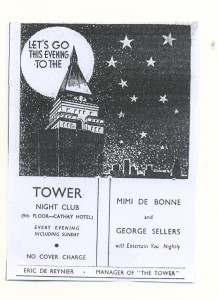
The Financial Times has a piece on the reopening after a big refurbishment of the Cathay Hotel (renamed the Peace Hotel and now to he the Fairmont Peace Hotel)- the name it appears will not be restored. Lots of claims all round about how good and true the restoration has been – well, we’ll wait and see about that- we’ve heard the same guff many times before on various projects from the not bad Astor Hotel and the old abattoir to the vandalised No. 3 The Bund and others. Getting the Cathay back to original is now of course impossible as so much was stripped in previous dreadful and most unhelpful ‘restorations’ but a good approximation should be possible. Fairmont, the developers in bed with the state-controlled Jinjiang Group on the project say they want a ‘repositioning’ rather than a restoration as otherwise a full restoration would make it a ‘dowdy museum piece’. However, if you restore the hotel well it should be a return to what it was – the greatest hotel in Asia and a lot of fun. It was the post-1949 controller who turned it into a badly maintained, poorly run ‘dowdy museum piece’.
So here’s hoping the restoration will be good. In the FT Yang Weimin, the CEO of state-controlled Jin Jiang International Hotels, says the company must abide by historical preservation laws. Old Shanghai hands have of course heard that before. We’ll wait and see with fingers crossed. And why not go back to the Cathay Hotel and drop this Peace Hotel crap?
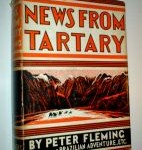
As the current events in Xinjiang unfurl the Times has reached for its archive rather swiftly to call up the articles sent to the paper in 1935 by their Special Travel Correspondent Peter Fleming across Xinjiang (or Turkestan as was). I’ll assume Fleming needs no introduction to readers of this blog.
Fleming was in Xinjiang at an interesting time: local rebellions, Chinese attempts to reassert control, Soviet scheming, warlords rampaging. The w hole thing of course became his book News From Tartary (first edition cover below).
No need to go on as you can read the articles Fleming sent back – Rivalries in Sinkiang – from the Times archive here. The Times archive also has some very funny and amusing non-China writing by Fleming too including his classic piece on bald men and the superiority of the nose over the chin – here
Fleming was, despite the overuse of the term, a genuine original and now a rare classic – take a stroll though his archive and enjoy.
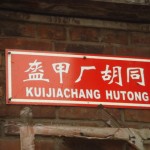
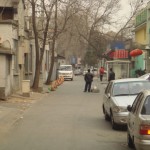
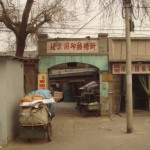
Yesterday I spent a very pleasant but humid afternoon strolling around Beijing’s Kuijiachang Hutong. It’s a miracle to me the hutong still exists. It’s sandwiched between the ghastly Marriot Hotel on the second ring road and the main railway line into Beijing station and not far from the Dongbianmenqiao (Fox Tower). Somehow it has avoided the wreckers ball and being turned into yet another marble palace luxury mall and long may it remain where and as it is – a thriving community of households, small businesses and Beijingers lolling around playing cards.
I was there with Evan Osnos, the China correspondent with the New Yorker(who also write a great blog on China) and we were making a short about my new book on the history of foreign correspondents in China. Hopefully it’ll turn out OK and pass whatever quality tests the stylish and sophisticated New Yorker has (which perhaps my British teeth and 10 kuai haircut will fail!!).
Kuijiachang hutong seemed a suitable place to stroll and film as a lot of foreigners lived there in the 1930s – a sort of overspill from the nearby Legation Quarter. Enterprising Chinese landlords installed western toilets and better plumbing to attract those who wanted hutong life and western conveniences. Among those who lived along what was then Armour Factory Alley were Edgard and Helen (Foster) Snow. It was 1937 and Snow lived on the street while finishing Red Star Over China which of course became a best seller.
If the video ever appears and my bad haircut and London accent make it onto the New Yorker I’ll post a link.
Without doubt Philip Pan’s Out of Mao’s Shadow is one of the most important books about China’s recent history (and likely future development) to appear in some time. Dealing with various refuseniks, dissidents and ordinary folk coming up against the monolithic Communist Party apparatus (and its friends) it shows above all through the tales Pan tells that a might reckoning is still to be had in China.
Personally, I’ve long believed that the Communists are simply an interruption to the progress of Chinese history, an annoying hick-up that is taking some time to remove before the republican experiment can be resumed. They have no longer-term historical legitimacy and maintain their rule by spreading ignorance and using their fists. They are a temporary aberration eventually to be removed. However, that doesn’t mean that life under their rule is very pleasant for many people and these are tales varying from grass roots workers’ organisations to the attempt to recover some sort of collective historical memory of events such as the Cultural Revolution and Tiananmen against the Party’s massive efforts to erase such inconveniencies.
When reviewing a collection of essays (albeit interconnected) it’s tempting to pick a winner. But Pan has achieved a rare thing – they’re all winners. For those that follow China relatively closely some of the stories will be familiar- the barefoot lawyers or independent labour organisers for instance. However, Pan never slips into the glorification of these people – they are invariably doing good work but it is hard. And, as this is real life, people do become afraid, they fear punishment and sometimes feel the need to retreat. It’s a narrative of struggle that doesn’t always fit the Western ideal of a dissident or a rebel but it is the way it is.
As this is a history blog it’s worth noting that a couple of essays at the start of the book dealing with the Cultural Revolution are revealing and lesser known stories. A filmmaker obsessed with recovering a footnote of the CR, one woman’s tragic story, is fascinating while another about a man who is chronicling and detailing one of the last surviving graveyards for those that died in the CR (in Chongqing) is amazing. That such a place exists (and may well not now as this was a few years ago and Chongqing as well as the party’s rewriting of its history) moves fast.
Pan’s book is one of the most important additions to the English language selection of China books of recent years and deserves to be read widely.
Philip Pan’s website and blog – http://www.outofmaosshadow.com/
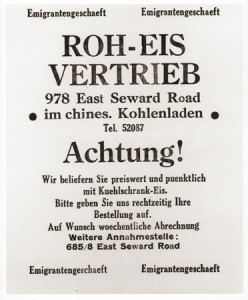 Shanghai’s temperature hovers in the mid-30s (just shy of 90 degress in old money) with humidity around 63% – i.e. sweltering and sweaty. Fortunately in 2009 we stick the air-con on. In the 1930s the only way to get some relief might have been to call German refugee Ralf Harpuder and his block ice business based at 978 East Seward Road (now Changzi Road East). Seems it might have helped if you spoke German.
 My great hero George Orwell wrote an essay in 1946 that all published, not yet quite published, wanna-be published and ever hopeful writers should read. It was simply called Why I Write. Owell outlined four reasons:
 As ever of course Orwell (who never did a China book tour) is right but what do you actually get for free when you book tour China in these recessionary times? Having just completed a mini-book tour of China here’s a round up of the tangible stuff you can get while promoting a book in China place by place and in the order I did them:
 The website
  Whatever the politics of the film it might be fun. For sure the Tigers’ shark-faced fighters should make for good visuals. The Tigers were paid combat bonuses for destroying nearly 300 Japanese aircraft while losing only 14 pilots on combat missions. When they hot the town in Kunming, Chunking or later Shanghai they were fairly legendary for their partying too.
 There was a 1942 film with John Wayne about the Flying Tigers called, eerr,
  Spent a few hours at The Langham the other day (The Langham Yangtze Boutique to give it it’s full name – it is of course nowhere near the Yangtze but the hotel there previously was called the Yangtze for decades before) in Shanghai. The property – which is stunning – originally opened as an art deco masterpiece in the 1930s aiming largely for an upmarket Chinese clientele and was touted as “The Third Largest Hotel in the Far East†by the renowned architect, Li Pan.
 The
The 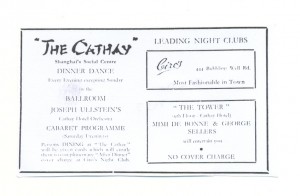 So here’s hoping the restoration will be good. In the FT Yang Weimin, the CEO of state-controlled Jin Jiang International Hotels, says the company must abide by historical preservation laws. Old Shanghai hands have of course heard that before. We’ll wait and see with fingers crossed. And why not go back to the Cathay Hotel and drop this Peace Hotel crap?
 As the current events in Xinjiang unfurl the Times has reached for its archive rather swiftly to call up the articles sent to the paper in 1935 by their Special Travel Correspondent Peter Fleming across Xinjiang (or Turkestan as was). I’ll assume Fleming needs no introduction to readers of this blog.
 No need to go on as you can read the articles Fleming sent back – Rivalries in Sinkiang – from the Times archive
  Yesterday I spent a very pleasant but humid afternoon strolling around Beijing’s Kuijiachang Hutong. It’s a miracle to me the hutong still exists. It’s sandwiched between the ghastly Marriot Hotel on the second ring road and the main railway line into Beijing station and not far from the Dongbianmenqiao (Fox Tower). Somehow it has avoided the wreckers ball and being turned into yet another marble palace luxury mall and long may it remain where and as it is – a thriving community of households, small businesses and Beijingers lolling around playing cards.
 I was there with Evan Osnos, the China correspondent with the
  Kuijiachang hutong seemed a suitable place to stroll and film as a lot of foreigners lived there in the 1930s – a sort of overspill from the nearby Legation Quarter. Enterprising Chinese landlords installed western toilets and better plumbing to attract those who wanted hutong life and western conveniences. Among those who lived along what was then Armour Factory Alley were Edgard and Helen (Foster) Snow. It was 1937 and Snow lived on the street while finishing Red Star Over China which of course became a best seller.
 If the video ever appears and my bad haircut and London accent make it onto the New Yorker I’ll post a link.
 Without doubt Philip Pan’s