The destruction of Hongkou at the moment is horrific but destruction does open up some new perspectives. The Embankment Building on Suzhou Creek was completed in 1932 with 194 apartments over 8 floors. It was a seriously modern building at the time as befitted the client Sir Victor Sassoon. Three additional floors were added in the 1970s, relatively seamlessly.
Now due to the demolition of some buildings behind the Embankment Building you can get a pretty good look at the structures backside and turret from the rear. I’m told people have been converting apartments inside the building back to their original size and with original fixtures.
The other day I posted on the widespread destruction presaged by EXPO of large areas of the city – notably the traditionally working class areas of Hongkou, Yangtzepoo etc. Readers of that post will notice that I am not much of a photographer! Fortunately Howard French (no relation) of the New York Times is a rather excellent photographer and has captured what I hadn’t a hope in hell of snapping with my wonky eyes – some great shots of areas slated for destruction as we move towards the glory of ‘Better City, Better Life, Endless Shopping Malls’
The BBC has some of his work up as a slideshow – click here
Well done to Hong Kong University Press (they really are an excellent publisher – and not just of me!) for reviving some of the works of Austin Coates in new editions. For those not familiar with him, Coates (1922–97), was a former senior British civil servant in Hong Kong, Malaya, and Sarawak, who left government service at age forty to pursue a professional writing career. Widely regarded as the most distinguished English-language author in Hong Kong, Coates remained a long-time Hong Kong resident, later dividing his time between Hong Kong and Portugal, where he died.
Now HKUP have republished four Coates classics – three on Macao and one on Hong Kong:
City of Broken Promises – The city is Macao, the Portuguese settlement on the China Coast, as it was more than 200 years ago. The promises are those made by Englishmen to marry their Macao mistresses, only to leave them abandoned and their children bastards. Martha Merop and her English lover are unique in this period. He, son of the founder of Lloyd’s and cousin of the philosopher, Jeremy Bentham, was one of the first merchants to oppose the trade in opium. She, Chinese, abandoned at birth and sold into prostitution at the age of thirteen, became an international trader in her own right, the richest woman on the China Coast and Macao’s greatest public benefactress. This moving novel that captures the time and place so convincingly is a historical reconstruction of the years 1780 to 1795 when the two were together. It is based on oral tradition handed down through generations in Macao, and on documents that survive about them in Macao, Lisbon and London. Austin Coates identified Martha Merop’s lover, about whom little was known. The documents about him confirmed the traditional Macao story, and the outcome was this book.
A Macao Narrative– Macao, 40 miles west of Hong Kong, became a place of Portuguese residence between 1555–57. In this short, lively and affectionate book, Austin Coates explains how and why the Portuguese came to the Far East, and how they peacefully settled in Macao with tacit Chinese goodwill. Macao’s golden age, from 1557 to the disastrous collapse of 1641, is vividly reconstructed. There follows the cuckoo-in-the-nest situation of the late eighteenth century when the British in Macao were a law unto themselves, until the foundation of Hong Kong and the opening of Shanghai gave wider scope for their energies. Portugal’s subsequent struggle to obtain full sovereignty in Macao, and the extraordinary outcome in 1975, brings this account to a close. Special tribute is paid to the risks Macao gallantly undertook in harbouring Hong Kong’s starving and destitute during World War II.
Macao and the British, 1637-1842: Prelude to Hong Kong – The story of the British acquisition of Hong Kong is intricately related to that of the Portuguese enclave of Macao. The British acquired Hong Kong in 1841, following 200 years of European endeavours to induce China to engage in foreign trade. As a residential base of European trade, Portuguese Macao enabled the West to maintain continuous relations with China from 1557 onwards. Opening with a vivid description of the first English voyage to China in 1637. Macao and the British traces the ensuing course of Anglo-Chinese relations, during which time Macao skillfully – and without fortifications – escaped domination by the British and Chinese. The account covers the opening of regular trade by the East India Company in 1770, including the ‘country’ trade between India and China and Britain’s first embassies to Peking, and relates the bedeviling effect of the opium trade. The story culminates in the resulting war from which Britain won, as part of its concessions, the obscure island of Hong Kong. Among those who feature in this lucid and lively account are the merchant princes Jardine and Matheson, the missionary Robert Morrison, the artist George Chinnery, and Captain Charles Elliot, Hong Kong’s maligned founder.
The Road – Set in 1950s Hong Kong, The Road paints an evocative picture of comfortable colonial life, while at the same time presenting the local people with the shrewd understanding that the author had acquired as a District Officer in rural Hong Kong. Perhaps the central character is the road itself, now easily recognized as the very real Lantau coast road. But in this novel, the road was an idea tossed off by the Acting Governor between cocktails in the course of a launch picnic. To Richard, the District Officer, the road was a challenge, something of his own to be achieved; an achievement, furthermore, that would spell progress for the Chinese villagers. To Richard’s wife Sylvia, an intelligent woman notorious for an ancient affair which she had publicized in a best-selling novel, the road was a new threat to a marriage already riven with complexities. To the island’s villagers, who did not want the road or the changes it would bring, it was the end of a way of life and further evidence that the foreign devils were quite mad. And to the villagers’ more worldly kin, the road was a god-sent invitation to graft.
History doesn’t repeat itself but it does rhyme is the Mark Twain inspired motto of this blog. Merrill Lynch, Lehman Brothers – they and others all prioritized China as a place to make money and not a few bankers have pushed out books and business guides to China in recent years. Yet they still at best have seen their global fortunes turn to dust and at worst failed and been wiped out.
And so it seems it was ever thus. In the 1330s the prestigious Florentine banking house of Bardi prioritised the China market. Francesco di Balducci Pegolotti, an agent of the Bardi banking house visited and wrote a manual for merchants travelling to Asia Minor and on to China in 1340 – La Pratica della Mercatura(The Principles of Commerce). Pages of the book are shown opposite – as you can see is much nicer than todays bullet pointed business guides (for MBA students with a poor grasp of history it was not available for the Kindle) . Pegolotti followed the Mongol trading routes to Gansu and on to Kambalik. His book was full of interesting tips for the commercial traveller including an exhaustive list of commodity prices (including spices, metals and, reflecting technological progress, waste paper for recycling) across the East and practical tips for the early businessman such as not shaving, letting your beard grow long, taking silver to exchange for paper money at the Chinese border, learning the Tartar language and not forgetting to pick up a woman to accompany you to China while still in Mongolia as well as (the still useful tip of) how to spot fake silk.
Did all this knowledge and prioritizing help the Bardi banking house to thrive? Sadly no – in 1343 the bank collapsed due to defaulters closer to home including King Edward III of England (left and a very sub-prime kind of monarch). One day the bank was talking up the China market as the next big thing thanks to their new found wealth and the next they were bankrupt as their creditors defaulted. See, history really does rhyme.
The New York Times has a nice article on a new exhibition in Macao entitled A Journey through Light and Shadow — The Invention of Photography and the Earliest Photographs of Macao, China, (as if there’s any other Macao!!) which will run until August 23rd at the Museum of Macao. There are also early pictures of Hong Kong and Mainland China. The New York Times article also has a slide show of images worth browsing.
As I’ve argued before one side effect of the ridiculous Shanghai EXPO and its drivel driven slogan ‘Better City, Better Life’ is that the city will probably lose more old buildings this year in the run up to the shenanigans than any previous year. One area particularly keen on mass demolition is the Hongkou District where absolutely nothing seems safe in 2009. Around Qipu Lu a vast amount of old housing has been demolished so far this year and it seems that there’s no end in sight – most will apparently be replaced with yet more shopping malls.
The old Bank of China warehouse (now the offices of a logistics company) along Suzhou Creek is one of the best 1930s buildings left along the Creek. Though the Creek is undoubtedly cleaner than it used to be many of the buildings along the embankments have been raised while it is impossible to follow the pathway along the creek without encountering areas of private land that prevent access – a great shame and a wasted opportunity.
Still, the Bank of China warehouse between the Xizang Lu (formerly Thibet Road) bridge and Wenan Lu (formerly Winchester Road) remains a nice building and in pretty good shape – on the outside at least.
The original India Pale Ale was pure gold in a glass a semi-mythical beer from the late 18th century, brewed in Britain to travel halfway around the world, through ocean storms and tropical sunshine, and arrive in perfect condition for a long, cold drink on an Indian veranda. And although you can still buy beers with ‘IPA’ on the label today, most are, frankly, pale imitations of the original. For the first time in 140 years, a keg of traditional Burton IPA has been brewed for a voyage to India by canal and tall ship, around the Cape of Good Hope; and the man carrying it is award-winning beer writer Pete Brown. Brazilian pirates and Iranian customs officials lie ahead, but will he even make it that far, having fallen in the canal just a few miles outside Burton-on-Trent? And if Pete does make it to the other side of the world with ‘Barry’ the barrel, one question remains: what will the real IPA taste like? Weaving first-class travel writing and new historical research with assured comedy, Hops and Glory is both a rollicking, raucous history of the Raj and a wonderfully entertaining, groundbreaking experiment to recreate the finest beer ever brewed.
 The destruction of Hongkou at the moment is horrific but destruction does open up some new perspectives. The Embankment Building on Suzhou Creek was completed in 1932 with 194 apartments over 8 floors. It was a seriously modern building at the time as befitted the client Sir Victor Sassoon. Three additional floors were added in the 1970s, relatively seamlessly.
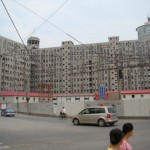 Now due to the demolition of some buildings behind the Embankment Building you can get a pretty good look at the structures backside and turret from the rear. I’m told people have been converting apartments inside the building back to their original size and with original fixtures.
 The other day I posted on the
  City of Broken Promises
 A Macao Narrative
  Macao and the British, 1637-1842: Prelude to Hong Kong
 The Road
 And so it seems it was ever thus. In the 1330s the prestigious Florentine banking house of Bardi prioritised the China market. Francesco di Balducci Pegolotti, an agent of the Bardi banking house visited and wrote a manual for merchants travelling to Asia Minor and on to China in 1340 –
 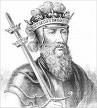 Did all this knowledge and prioritizing help the Bardi banking house to thrive? Sadly no – in 1343 the bank collapsed due to defaulters closer to home including King Edward III of England (left and a very sub-prime kind of monarch). One day the bank was talking up the China market as the next big thing thanks to their new found wealth and the next they were bankrupt as their creditors defaulted. See, history really does rhyme.
 The New York Times has a nice article on a new exhibition in Macao entitled A Journey through Light and Shadow — The Invention of Photography and the Earliest Photographs of Macao, China, (as if there’s any other Macao!!) which will run until August 23rd at the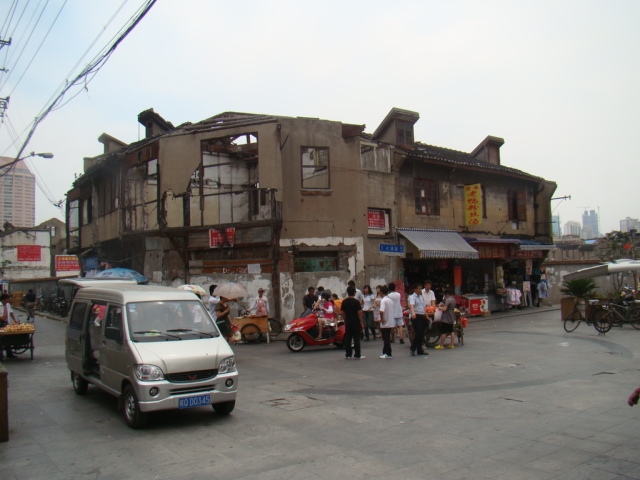
 As I’ve argued before one side effect of the ridiculous Shanghai EXPO and its drivel driven slogan ‘Better City, Better Life’ is that the city will probably lose more old buildings this year in the run up to the shenanigans than any previous year. One area particularly keen on mass demolition is the Hongkou District where absolutely nothing seems safe in 2009. Around Qipu Lu a vast amount of old housing has been demolished so far this year and it seems that there’s no end in sight – most will apparently be replaced with yet more shopping malls.
 The old Bank of China warehouse (now the offices of a logistics company) along Suzhou Creek is one of the best 1930s buildings left along the Creek. Though the Creek is undoubtedly cleaner than it used to be many of the buildings along the embankments have been raised while it is impossible to follow the pathway along the creek without encountering areas of private land that prevent access – a great shame and a wasted opportunity.

 Of course I’ve drunk a lot of IPA over the years (Greene King mostly) but hadn’t thought about it much beyond the fact that ‘I’ stood for India. So I was pleased to hear about Pete Brown’s new book on the history of IPA,